

Without an account
- Enter freely and use the whole learning platform
- Keep track of your progress
- Save notes, decisions, and artifacts in My Map
- Export your learning map
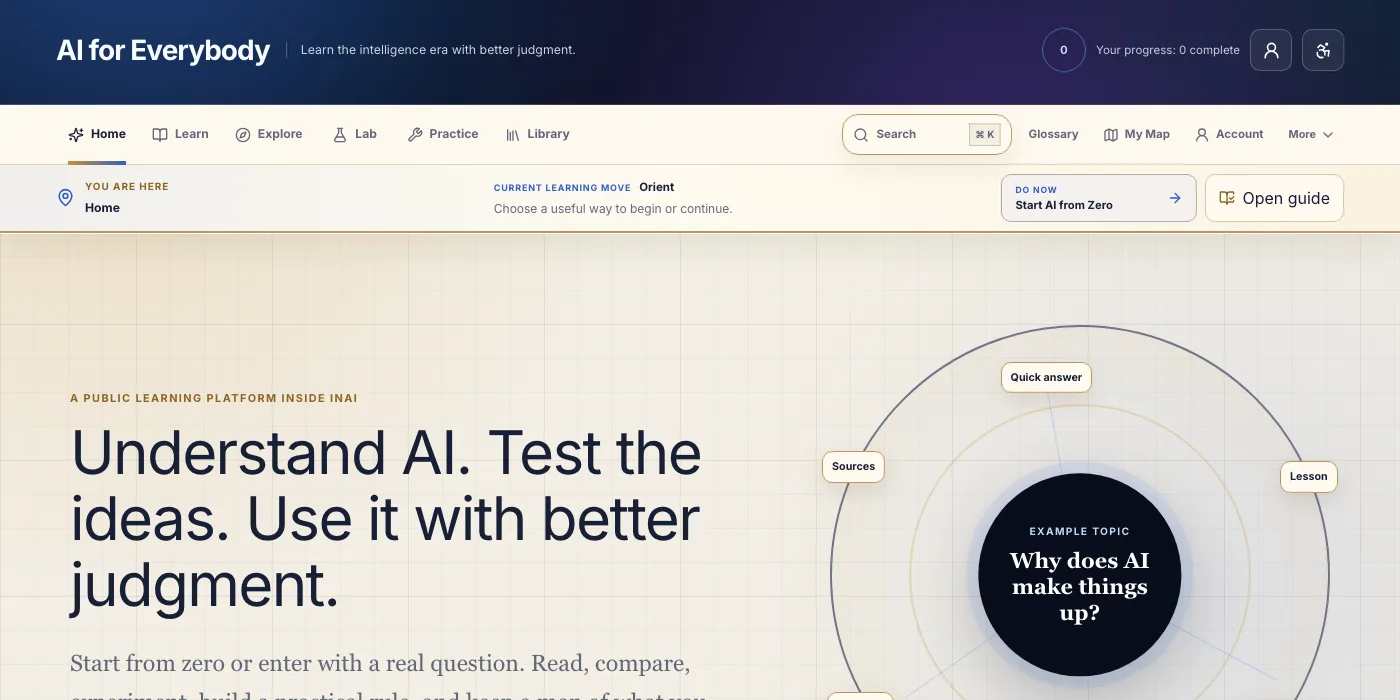
AI for Everybody
From first principles to agents, work, trust, history, and the questions shaping the field now.
Structured learning paths, interactive Labs, practical tools, trusted sources, and a connected library.
Already inside
One platform, several ways to learn
Choose a mode to look directly into the working platform. Every view below is loaded from the real internal application.
Begin with AI from Zero or continue through work, agents, trust, education, and modern AI systems.
Move through topics, concepts, people, history, sources, and media instead of reading isolated articles.
Predict a result in a controlled Lab, reveal the reviewed outcome, and understand what changed.
Turn decisions into a checklist, plan, map, or other reusable artifact without receiving a score.
Open annotated courses, videos, reports, and sources with context on level, perspective, access, and limits.
Keep progress, resources, notes, decisions, and artifacts locally—and return to a chosen next direction.
A useful first visit
Three different entrances, each designed around a concrete outcome.
Leave with a first map of AI, one caution rule, and a clear next direction.
Leave with a verification checklist, privacy rule, workflow map, or other reusable artifact.
Move between explanations, concepts, history, videos, evidence, and structured further study.
My Map, your choice
Ordinary learning stays open. An inAi account adds continuity when that becomes useful to you.
Why this exists
AI is entering everyday work, software, education, creativity, and decision-making. inAi created AI for Everybody to make that change understandable, source-aware, and useful—part of bringing AI into the real world responsibly.
Related inAi layers
Continue into the technical, research, and trust layers that sit around the learning platform.
Your next step
Start from zero, enter with a question, or return to something you already began.